
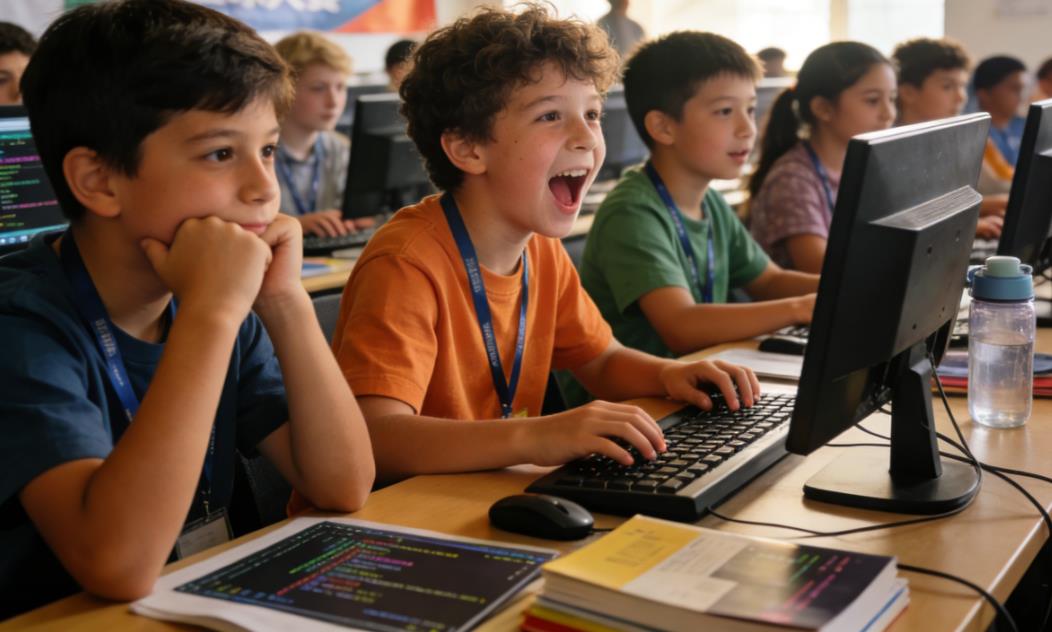
For many parents in Europe and North America, the idea of exposing their children to coding is exciting but often raises questions about timing, readiness, and practical benefits. Among the most common questions is: “At what age should kids start participating in coding competitions?” This is a nuanced topic that intersects child development, cognitive readiness, social-emotional growth, and the practical structure of competitions themselves.
Participating in coding competitions can be highly beneficial, but timing is critical. Starting too early may cause frustration, while starting too late could mean missing foundational learning opportunities. This article aims to provide a comprehensive, research-backed guide for parents, educators, and young learners, offering real-world examples from coding competitions popular in Europe, the United States, and other Western countries.
Understanding Child Readiness for Coding Competitions
Before setting a specific age, it’s essential to understand what makes a child “ready” for coding competitions. Readiness is multidimensional and includes:
Cognitive Skills: Children need basic problem-solving abilities, logical thinking, and the capacity to handle multi-step instructions. Most children develop these skills around ages 7–10, but some exceptionally advanced learners can demonstrate them earlier.
Reading and Comprehension: Many competitions require reading instructions, understanding problem statements, and sometimes interpreting code snippets. Fluent reading comprehension is generally essential from age 7–8 onward.
Attention Span and Focus: Coding competitions are not short activities. Even beginner-friendly competitions often require sustained focus for 30–60 minutes or longer. Children younger than 7 may struggle to maintain attention.
Emotional Resilience: Competitions inherently involve challenges, mistakes, and sometimes failure. Children must be able to handle frustration and approach errors as learning opportunities.
Motivation and Interest: A strong interest in coding or digital problem-solving often predicts success. Forcing a child to participate before they are genuinely curious or motivated can be counterproductive.
Popular Coding Competitions for Children
Understanding the landscape of coding competitions helps contextualize age recommendations. Some popular competitions in Europe and North America include:
Code.org’s Hour of Code and Local Challenges: Primarily targeted at beginners and ages 6–12, often using block-based programming tools like Scratch. Many schools integrate these activities into their curricula, giving children a low-pressure introduction to competition-style coding.
Scratch Olympiads and Scratch Day Challenges: Scratch-based competitions are highly accessible to children ages 7 and above. These competitions emphasize creativity, storytelling, and problem-solving, making them ideal for early exposure.
CoderDojo Coding Challenges: CoderDojo runs local and global challenges for kids aged 7–17. Early rounds often focus on block-based coding, moving into text-based coding as participants gain experience.
USACO (USA Computing Olympiad): USACO introduces programming competitions for children as young as 10, but most beginners start around 12, as the contests require stronger problem-solving skills and familiarity with text-based languages like Python or Java.
Bebras Challenge: An international computational thinking competition designed for ages 8–18. It emphasizes logic and algorithmic thinking over programming syntax, making it ideal for younger participants who may not yet know how to code in text-based languages.
Kodable, Tynker, and Blockly Games Competitions: These gamified platforms host mini-challenges and tournaments suitable for children aged 6–10, primarily using visual block-based programming.
Recommended Age Ranges
Based on research, educational practice, and competition design, the recommended starting ages for coding competitions are:
Ages 6–8: Best suited for introductory competitions using visual block-based coding (e.g., Scratch, Blockly). Focus is on creativity, logic puzzles, and collaborative learning rather than high-stakes competition. For example, in the UK’s Code Club competitions, children as young as 7 successfully participate in team challenges with guided mentoring.
Ages 8–10: Children in this range can start participating in beginner-level coding competitions that mix visual and simple text-based programming. The emphasis remains on problem-solving and creativity, but children can handle short coding problems independently. For example, some CoderDojo clubs in the United States run competitions for 8–10-year-olds where participants solve logic puzzles and create basic interactive games.
Ages 10–12: Many children are ready for intermediate competitions using text-based languages like Python. At this stage, they can handle multi-step algorithms, debugging, and simple optimization problems. For instance, USACO’s Bronze division often sees successful participation from children aged 10–12 who have a solid foundation in Python or JavaScript.
Ages 12 and above: Teenagers are generally capable of participating in more advanced competitions with minimal guidance. They can tackle complex algorithmic challenges, competitive programming problems, and larger team-based projects. Many Olympiad-style competitions, such as USACO Silver and Gold, expect participants to have years of prior experience.
Real-World Case Studies
Case Study 1: Emily, Age 7 – Scratch Competition
Emily, a second grader in Kansas City, participated in her local school’s Scratch coding challenge at age 7. The competition emphasized storytelling, interactive animations, and logical sequences rather than code efficiency. Emily thrived, creating a game that won the “Most Creative” award. Early participation fostered confidence, curiosity, and the habit of iterative problem-solving, setting her up for more advanced competitions in later years.
Case Study 2: Liam, Age 10 – CoderDojo Coding Challenge
Liam, a 10-year-old from London, joined a CoderDojo competition involving Python-based challenges. Although initially intimidated by text-based coding, his mentor provided structured guidance on basic loops and functions. Liam completed all tasks and developed a small game. The experience boosted his self-confidence and motivated him to practice coding regularly, eventually leading him to participate in USACO Bronze competitions by age 12.
Case Study 3: Sofia, Age 12 – Bebras International Challenge
Sofia from Madrid participated in the Bebras Challenge at age 12. The contest focused on algorithmic thinking and logic puzzles rather than programming syntax. Sofia excelled and earned a gold medal. This experience strengthened her computational thinking skills and made the transition to text-based coding smoother in middle school.
These case studies illustrate that the benefits of early participation go beyond winning. They nurture computational thinking, problem-solving, and resilience, which are foundational for future success.
Benefits of Early Participation
Participating in coding competitions has multiple benefits for children when age-appropriate:
1. Cognitive Development: Competitions encourage logical reasoning, pattern recognition, and algorithmic thinking. Research shows that children exposed to coding activities early develop stronger problem-solving skills and mathematical reasoning.
2. Confidence Building: Completing coding challenges and receiving recognition fosters a sense of achievement. Even non-winning participants gain confidence in their abilities and learn to approach challenges with curiosity rather than fear.
3. Exposure to Peer Learning: Competitions often involve team challenges or shared platforms where children see diverse approaches to problem-solving. Peer learning can accelerate skill development and encourage collaboration.
4. Preparation for Future Opportunities: Early exposure to coding competitions helps children develop portfolios of projects and achievements that can be valuable for high school, university applications, and STEM scholarships.
5. Motivation and Engagement: Gamified competitions make learning fun and engaging. Children are more likely to continue coding and exploring technology when introduced through enjoyable competitive experiences.
Challenges and Considerations
While early participation has many advantages, there are challenges parents should consider:
Overemphasis on Winning: Competitions can create pressure, especially if children are too young. At early ages, emphasis should be on participation, creativity, and learning rather than winning.
Screen Time Management: Coding competitions require computer use, which can contribute to excessive screen time if not balanced with physical activity and offline learning.
Varied Skill Levels: Age does not always correspond to skill level. Some younger children may excel beyond their peers, while others may need more time. Flexible approaches and tiered competitions can help.
Mentorship Needs: Younger participants often require guidance from teachers, mentors, or parents. Adult involvement is crucial to ensure children understand the problems and can navigate competition tools effectively.
Best Practices for Parents
- Start Small: Introduce your child to low-pressure, creative coding challenges before formal competitions. Platforms like Scratch, Tynker, and Code.org offer excellent starter activities.
- Observe Readiness: Watch for interest, problem-solving behavior, and patience. If a child enjoys coding puzzles and can focus on tasks for 20–30 minutes, they are likely ready for beginner competitions.
- Emphasize Learning, Not Winning: Encourage children to view competitions as opportunities for growth rather than a test of intelligence. Praise effort, creativity, and persistence.
- Provide Mentorship: For younger participants, consider coaching, collaborative problem-solving, or team participation. This support helps children navigate technical and strategic challenges.
- Gradual Progression: Start with block-based competitions, then transition to beginner text-based challenges, and finally to intermediate and advanced contests as skills grow.
- Encourage Reflection: After competitions, discuss what went well, what was challenging, and what can be improved. Reflection helps children internalize lessons and develop critical thinking skills.
There is no one-size-fits-all age for children to start participating in coding competitions. For most children in Europe and North America, ages 7–8 are appropriate for introductory block-based competitions, while ages 10–12 are suitable for beginner text-based contests. Teenagers above 12 can tackle more advanced programming challenges.
The key is to consider each child’s cognitive, emotional, and motivational readiness, rather than relying solely on chronological age. Early, well-structured participation fosters problem-solving, creativity, collaboration, and resilience—skills that go far beyond coding and serve children throughout life.
Real-world experiences show that children who start early, under guided mentorship and with an emphasis on learning over winning, develop both technical competence and a love for coding. Whether a child participates at age 7 in a Scratch storytelling contest or at age 12 in a Bebras or USACO challenge, the ultimate benefit is cultivating a mindset of curiosity, persistence, and logical thinking that will last a lifetime.

Leave a Reply